
Finding Franklin Residents
Franklin resident records are strongest when the search begins with a defined question. A parcel owner, a voter-registration match, a court party, and a person named in a historical directory are different kinds of evidence. The Williamson County Property Search is useful when an owner name or property address is known. The free Archives index is a better first stop for an older name, especially when a record group such as probate, deeds, marriages, tax, burial, or obituaries is known. A court or vital record needs a narrower purpose and may have access limits.
Current official sources do not publish a complete list of every person at every Franklin address. An owner can be absent from the home, and a dated directory entry cannot establish a present connection. Keep the source date, record type, spelling, and search filters with every result. That small record of the search makes a later comparison far more useful.
- For a current parcel clue, search the assessor by owner name or property address.
- Record the parcel description, sale date, and the separate situs and mailing addresses.
- Use the Register of Deeds index for the legal transfer trail behind that parcel.
- For an earlier person or household, search the Archives by name and record group, then follow its book, reel, or file reference.
- Ask the correct custodian for a defined record when the online index ends.
Franklin Resident Records Offices
Franklin is the Williamson County seat, so the records behind a local resident search are divided among county, city, and state custodians. The assessor relates people to assessed property. The Register of Deeds holds the legal instruments that affect the property. The Election Commission is the local contact for registration questions, while the Archives and library keep older names, books, and microfilm. For a street-by-street property method, use the Franklin By Street directory rather than assuming a name search covers a whole block.
Williamson Register of Deeds
1320 West Main Street, Suite 201
Franklin, TN 37064
615-790-5706
Williamson Property Assessor
1320 West Main Street
Franklin, TN 37064
615-790-5708
Williamson Election Commission
405 Downs Boulevard
Franklin, TN 37064
615-790-5711
Note: Each office answers a different question, so the source that names a person should be read with its own date and access limit.
Franklin Parcel Clues by Address
The Williamson County Property Search is the practical bridge between a Franklin street address and the current assessed owner. It accepts an owner name, property address, subdivision, city, lot number, map, parcel, and last-sale dates. The results identify owner names, property address, city, parcel description, lot number, sale date, and price. That is a strong beginning for a residents directory search, but it is not a roster of occupants.
| Assessor field | Use in a Franklin search | Read with care |
|---|---|---|
| Owner Name | Find assessed ownership | An owner is not automatically a current occupant |
| Property Address | Find the situs parcel | Historic formats may differ |
| Subdivision, lot, map, parcel | Connect the property to legal and map records | Preserve the exact identifier |
| Sale dates | Spot a transfer lead | A displayed sale is not a full title chain |
The tax mailing address deserves its own column in research notes. It can be a post-office box, a trustee, a former address, or a different property. The situs is the physical parcel. Neither one, by itself, proves that every person connected to the record lives there.
Franklin Maps Set the Address
Address clues are easier to compare after a map check. The City of Franklin GIS offers address points, parcels, streets, buildings, city limits, zoning, historic-property, and other layers. Its CommunityMap service also exposes parcel identifiers, GISLINK, LRSN values, acreage, consideration, assessed and market values, and PLAN_ZONE. Those fields help relate the assessor result to a mapped location.
A map point is a geographic record, not a household statement. The service limits large queries to 2,000 records or selections, so a whole-neighborhood check may need smaller tax-grid or geometry searches. Record the layer URL and query date. Use the map to normalize the address before moving to an owner or deed search.
- Parcel
- A mapped unit of land identified in the assessor and GIS systems.
- Situs address
- The physical property location used for the parcel record.
- Mailing address
- The tax-correspondence destination, which may differ from the situs.
- Index
- A finding tool that points to a record; it may not include the original image.
Franklin Deeds Follow Legal Parties
Once a parcel identifies an owner or legal description, the deed route can explain a transfer. TitleSearcher supports grantor or grantee names, subdivision, document type, instrument number, recorded-date ranges, legal-description searching, and book or page monitoring. Its refer-backs point from a document to an earlier instrument. The service describes paid image access, while a certified copy remains a request for the county custodian.
Williamson County’s historical chain has a useful division. The house-history guide directs researchers to begin a post-1966 chain with the Register of Deeds. For earlier deeds, the Archives and Tennessee State Library and Archives microfilm provide index runs, including direct and reverse indexes for 1951 through 1966. A grantor is the person or entity conveying an interest; a grantee receives it. Either can be an estate, trustee, bank, or business, so the name is a legal-party clue, not a full resident list.
Note: A deed records a legal transaction and description, not continuous residence or every household member connected to the address.
Franklin Current Resident Records
Several current indexes can contribute a piece of a Franklin resident question. Their coverage differs sharply. Start with the source that actually records the relationship being tested, then use a second official or archival record to confirm the match. The local database is a set of separate rolls, not one master directory.
| Franklin source | Relationship it can support | Custodian | Access route |
|---|---|---|---|
| Property assessment | Assessed owner, situs, mailing, sale clue | Property Assessor | Free property search |
| Recorded instrument | Legal party and transfer | Register of Deeds | Portal, office, or historical index |
| Voter match | Registration match and district data when available | Election Commission | Required-field state lookup |
| City permit record | Application, location, status, and dates | City of Franklin | Accela Citizen Portal |
| Historical archive result | Name, date, group, and physical reference | County Archives | Free online index and Reading Room |
The city permit portal separates Building, Licenses, and Fire modules. Anonymous access is limited, and a visible application contact does not establish ownership or occupancy. Use a permit as a dated administrative clue, then ask the city custodian which fields are releasable if the online result is incomplete.
Franklin Voter Matches Need Five Fields
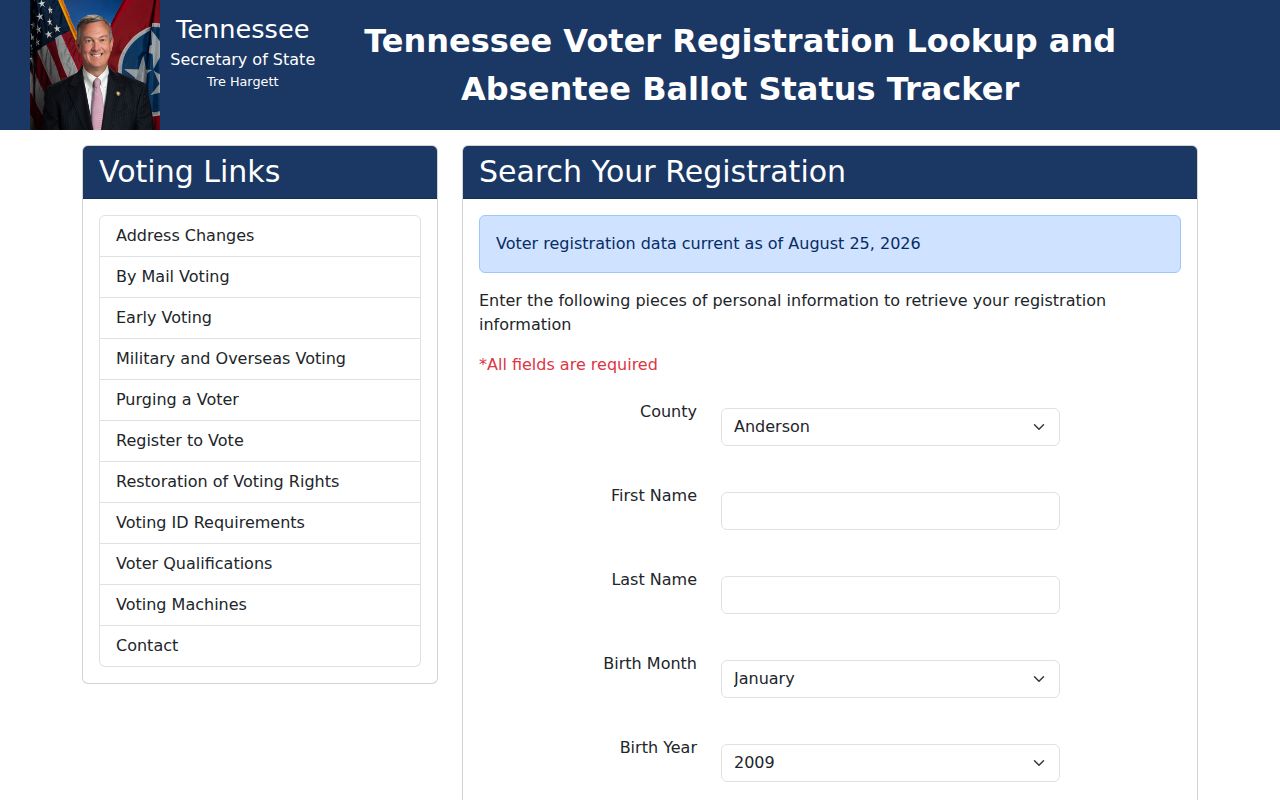
The Tennessee Voter Registration Lookup is an identity-match form, not a browseable Franklin residents directory. It requires county, first name, last name, birth month, and birth year. The form’s no-match instruction is to verify the details and contact the local Election Commission. Preserve the lookup date because voter status and district information can change.
The official lookup form shows the county, name, and birth fields needed to test a precise registration match.
Williamson County’s Election Commission is the follow-up custodian for registration and election questions. Tennessee excludes Social Security, driver-license, and Department of Safety identifiers from the public voter-record notice. A voter match should be combined with another record before making a person-to-address conclusion.
Franklin Court Searches Need Context
Court results can anchor a name to a case and date, but they do not automatically establish a Franklin address. TnCIS Web Inquiry lists Williamson County participation for Circuit Court, Clerk and Master, General Sessions Civil, and General Sessions Criminal searches by party name or case number. The county clerk counters at the Judicial Center handle record and copy questions. Sealed, expunged, restricted, confidential, and juvenile matters may be missing or limited.
The Tennessee appellate Public Case History provides a separate statewide route. It searches by case number, case style, party name, or business or organization, and it covers appellate matters after September 1, 2006. Linked filings generally begin after August 26, 2013. For a historical local court trail, the Archives index includes Circuit, Chancery, County Court, and Pleas and Quarter Sessions references that may require Reading Room follow-up.
Franklin Vital Records Have Gates
Vital records are useful for family-history and estate questions, but they are not a general name directory. Under the cited Tennessee rules, birth records become public after 100 years, while death, marriage, divorce, and annulment records generally become public after 50 years, subject to the statute’s safeguards. Newer certified copies require the right relationship or legal entitlement, identification, and the correct request channel.
Tennessee’s certificate instructions describe in-person, local county-health-department, mail, and authorized online routes. The state fee page lists a $15 standard birth, marriage, divorce, or death certificate fee, including a no-record search at the applicable rate. A library index or obituary can provide a lead, but the Office of Vital Records controls the certificate.
Franklin Residents Directory State Leads
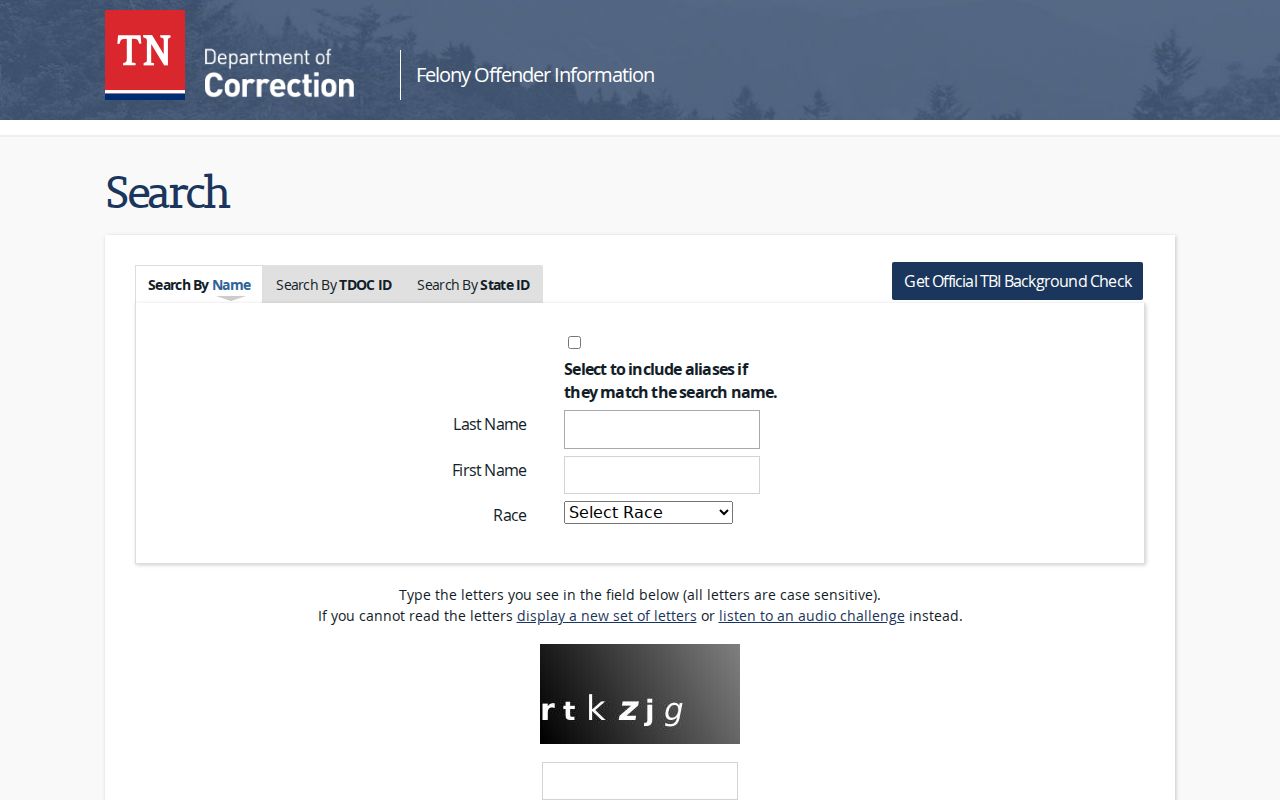
Some Franklin questions need a Tennessee-level source after the county search. The Department of Correction’s Felony Offender Information Lookup has separate name, TDOC ID, and State ID modes, with an alias option. It is a state-custody search, not a resident roll and not a replacement for a county jail inquiry. No official searchable Williamson County adult jail roster was located in the research sweep, so booking or bond questions should go to the Criminal Justice Center rather than being inferred from a state result.
The official Tennessee FOIL search presents the available identity paths for a narrowly defined state-custody query.
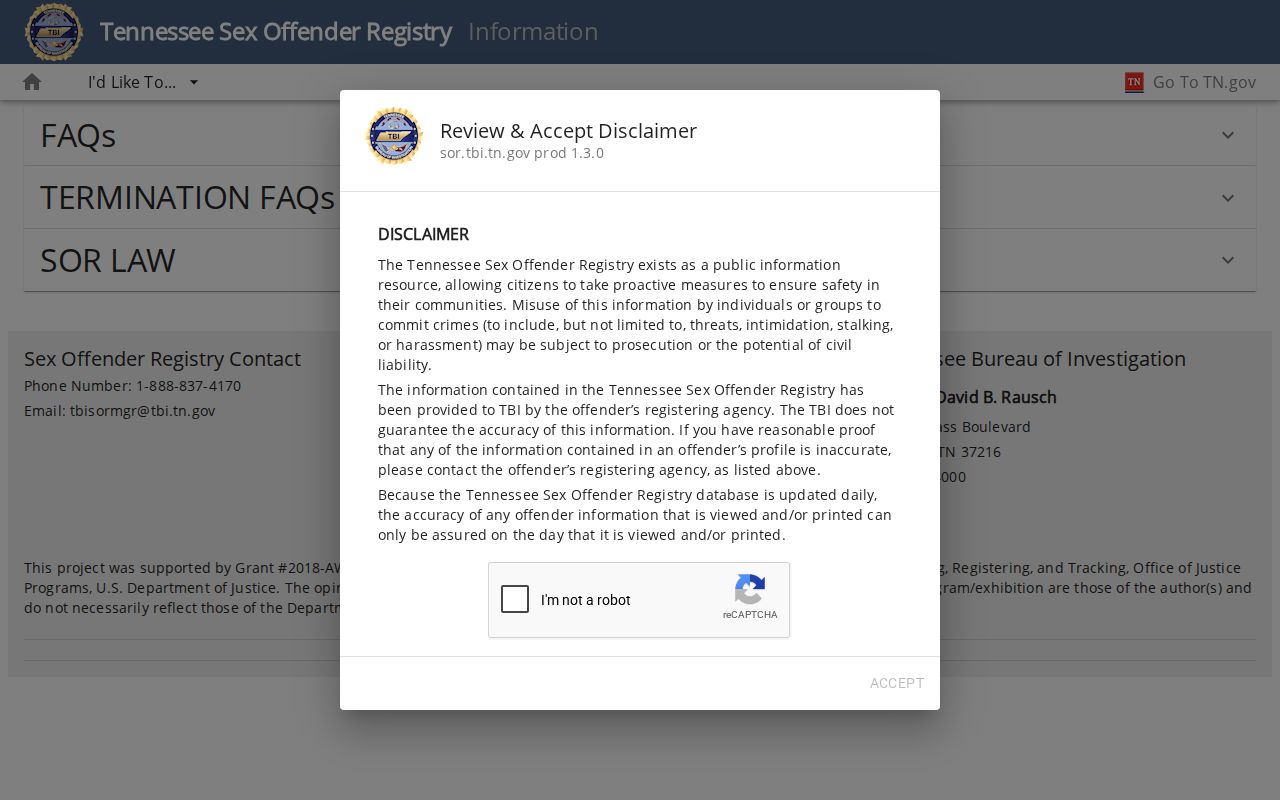
For covered public-safety registry information, the Tennessee Bureau of Investigation maintains a separate registry and states that it updates daily. Its statutory reporting rules and identity fields remain distinct from a Franklin residents directory search. Do not turn a state search outcome into a claim that a person currently lives at a local address.
The TBI registry information page explains the public-use context and its daily-update warning.
State results require the same care as county results: preserve the search date, distinguish a name match from identity verification, and use the agency’s stated procedures for a correction or access question.
Franklin Archives Have 405,000 Leads
The Williamson County Archives search is one of Franklin’s strongest historical-resident tools. Its online index has more than 405,000 entries and supports Name Search, Keyword Search, and Field Search. A result can identify a name, record group, date, and reference to a bound book, microfilm reel, loose file, or other physical item. It is a finding aid, so the result should lead to the underlying source instead of being treated as a complete image record.
The Reading Room at 611 West Main Street supplies the offline handoff. Archives coverage includes historic deeds, marriages, probate, wills, tax books, burials, obituaries, court records, road records, licenses, and chattel mortgages. The Reading Room information should be checked before a visit. Modern marriages and current deeds belong with the County Clerk or Register of Deeds.
Note: An Archives hit is a documented lead, and its book, reel, or file reference should be preserved before requesting the underlying item.
Franklin Records Need Two Sources
A reliable Franklin resident conclusion has an evidence trail. Compare exact spelling, initials, suffixes, maiden or former names, a time period, parcel or legal description, and family relationships. A common surname alone is not enough. Keep an explicit note about why two records refer to the same person, and report a non-match as not located in that particular search rather than making a broad claim.
| Official or archival record | Useful strength | Important limit |
|---|---|---|
| Assessor parcel card | Current assessed ownership and property clues | Does not list all occupants |
| Recorded deed | Legal party and dated property transfer | Does not prove continuous residence |
| Voter lookup | Precise registration match | Not a street-wide roster |
| City directory | Dated address and household clue | Not a current status record |
| Archive or newspaper lead | Historical name and context | Needs source-date and original verification |
Commercial people-finder products can be stale, combine same-name people, omit protected records, and charge for information that a custodian may provide through an official channel. The better Franklin practice is to retain the official result, archival reference, or clearly stated gap.
Franklin Historical Resident Directories
For a household from an earlier period, Williamson County Public Library Special Collections keeps city directories, newspapers, yearbooks, cemetery and burial material, historic court records, and microfilm. The collection is at 1314 Columbia Avenue and does not circulate its materials. Its online description confirms that city directories are available, but it does not publish a complete Franklin year or publisher run. Ask staff for the exact volume, year, page, and any address-first entry before relying on a directory claim.
The Archives and Tennessee State Library and Archives add tax, deed, probate, newspaper, and microfilm leads. The detailed collection approach belongs in the Franklin City Directories section, while an address history is best followed through the property chain. A printed entry is a dated snapshot, not a present-day residence finding.
Franklin Custodians Offer Fallbacks
When an online portal does not answer the question, Franklin has several documented alternatives. The archives and library offer in-person historical follow-up. County offices can confirm copy and certified-record procedures by phone or counter visit. The Tennessee Public Records Act, T.C.A. §§ 10-7-501 et seq., especially § 10-7-503, generally permits Tennessee citizens to inspect public records unless another law makes them confidential. A request should identify the record type, subject, date range, and custodian.
Inspection is generally free, while copies may carry reasonable duplication and qualifying labor charges. Williamson County may request Tennessee-address identification for a copy request and provide an estimate when costs apply. Court, voter, vital, juvenile, sealed, and Safe at Home records have their own limits. Those limits are a reason to contact the correct office, not a reason to fill a gap with an unsupported claim.
Franklin Portal Dates Can Change
Dynamic records need a date beside them. Williamson County’s 2025 through 2027 voter-list maintenance affects how an active or inactive registration might read. Franklin’s zoning ordinance became effective January 13, 2026, so a current zoning label should not be projected back onto an older deed or directory. The Assessor also reported a May 2026 remodeling arrangement, with limited staff in Suite 313 and most staff at 305 Beasley Drive, so an in-person visit should be verified first.
Portal prices, forms, images, office hours, and coverage can change without rewriting an older record. Preserve the public source URL, the access date, search terms, filters, and any coverage statement. That is the practical way to keep a Franklin residents directory search honest when records change over time.