
Franklin Resident Lookup Records
No single government roll identifies every person who lives in Franklin. Instead, a resident lookup can test a specific connection through the Williamson County property search, a Tennessee voter match, a court docket, an event record, or an archival reference. Each source answers a narrower question. The strongest result records the custodian, search date, spelling used, and what the source actually says. An owner name, for example, should be reported as assessed ownership rather than proof of present occupancy.
| Record | What It Confirms | Where | Access |
|---|---|---|---|
| Property roll | Assessed owner, situs, mailing, and sale clue | Williamson County Property Search | Public search; owner is not every occupant |
| Voter record | Required-field registration match and district context | Tennessee Voter Lookup | Five fields required; identifiers are excluded |
| Court docket | Party, case, date, and disposition lead | TnCIS or appellate case history | Restricted matters may be absent |
| Vital record | Birth, death, marriage, or divorce event | Tennessee Vital Records | Age and entitlement rules apply |
| Archives or library | Historical address, kin, or record reference | Williamson County Archives | Index result may require Reading Room follow-up |
Use the archive when the question is historical. Use the property roll when a parcel is known. A court clue belongs with the right clerk and case type. For a current civic-registration question, the state form is more limited than a general name directory. This separation keeps a Franklin resident lookup from turning into a broad, unsupported claim.
When an online result is incomplete, use the documented fallback chain. The Archives Reading Room can retrieve the historical item named by its index. WCPL Special Collections can provide local directories, newspapers, microfilm, and genealogy material. Court clerks can confirm case-number and copy procedures by phone or at the Judicial Center. A narrowly defined Tennessee Public Records Act request can go to the custodian for a nonconfidential record, while mail, fax, or email should follow that office's current instructions. State and county channels do not replace one another.
Set the Franklin Lookup Question
Write down the exact task before entering a name. A former resident, a legal party, an assessed owner, and an authorized vital-record requester take different routes. Include known initials, suffixes, former names, an approximate year, and a street or subdivision only when it is relevant. The Archives search offers Name Search, Keyword Search, and Field Search with record-group choices. Preserve the result's date and book, reel, or file reference, because that reference is a finding aid rather than the underlying record.
For names that recur, do not merge results simply because the surname is the same. Compare middle initials, age clues, a parcel's legal description, relatives, and dates. A city directory or dated obituary can supply a historical address, but it still needs corroboration. The library confirms city-directory holdings, while the exact online year runs were not located. A historical lead can be checked through the Franklin city directories and then against a county or archival record.
Note: Keep a no-result as “not located in this search” with the spelling, filter, date range, and custodian recorded.
Franklin Court Docket Searches
TnCIS Web Inquiry lists Williamson County options for Circuit Court, Clerk and Master, General Sessions Civil, and General Sessions Criminal. The documented workflow uses a party name or case number, then court and case-type choices. A result may show case type, case number, party name, filing date, event or disposition history, and selected document links. It is a docket lead, not a complete file. Sealed, expunged, confidential, protected, and juvenile material can be missing or reduced.
| Search detail | What to preserve |
|---|---|
| TnCIS query | Name spelling or case number, court, case type, and search date |
| Docket result | Case style, party role, filing date, events, disposition, and restriction notice |
| Appellate result | Search term and selected Case Number, Case Style, Party Name, or Business/Organization option |
The Tennessee appellate Public Case History covers appellate matters after September 1, 2006. Linked filings generally begin after August 26, 2013. Its absence does not disprove a Williamson County trial case. The local route is the Judicial Center clerk counter, phone confirmation, or a properly directed custodian request; historic court material can also be located through the Archives and WCPL Special Collections.
The appellate search screen documents the search modes used for this part of a Franklin resident lookup.
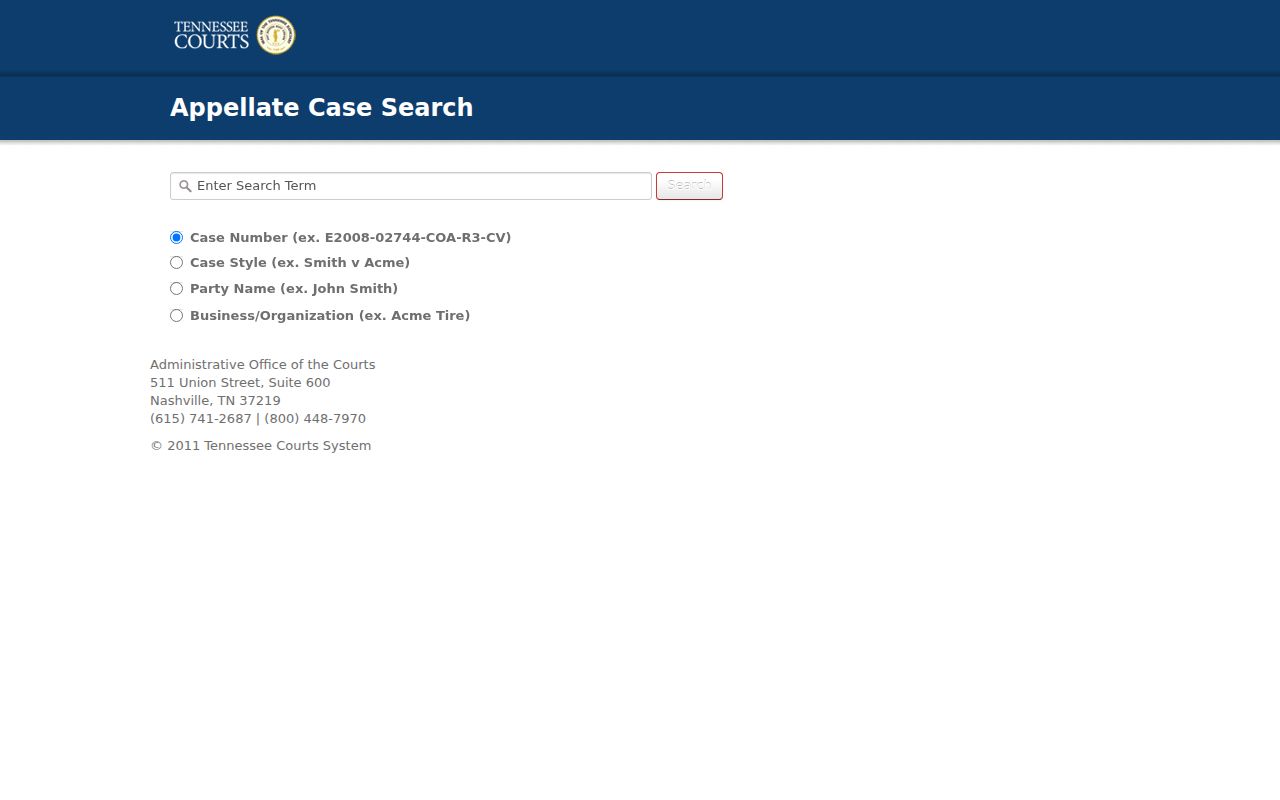
Use the result as a date-and-case connection, then ask the clerk identified by the case type about complete or certified copies.
Franklin Voter Match Limits
The Tennessee lookup requires county, first name, last name, birth month, and birth year. All five inputs are required, and an uncertain result should be taken to the Williamson County Election Commission rather than guessed from a similar name. The public-record notice excludes Social Security, driver-license, and Department of Safety identifiers. Tennessee does not use a party-registration field in the ordinary form, and ballot choices are not public voter-history fields.
The Election Commission is the local custodian for registration and election administration at 405 Downs Boulevard, Franklin, with telephone service at 615-790-5711. A lawful voter-file request has separate statutory certification and use restrictions under T.C.A. § 2-2-138. The live lookup is not a street-by-street browse tool, and a current record may change through the county's maintenance process. Preserve the live search date with any match.
Vital Records for a Franklin Lookup
Tennessee vital access depends on both the record's age and the requester's relationship or legal entitlement. Birth records become public after 100 years. Death, marriage, divorce, and annulment records become public after 50 years, subject to safeguards. Before those periods, an index or family statement does not grant a right to a certified copy. The state lists a $15 fee for each birth, marriage, divorce, or death certificate, and a no-record result carries the applicable fee.
Use the Tennessee certificate-request instructions to select an authorized channel: in person at the state office or a county health department, by mail with required identification and payment, or through the state's named online vendor. County health departments can issue statewide birth and death certificates. Phone contact can clarify entitlement and record year. A generic public-records request does not replace the vital-record application process.
The state instructions show the official channels behind a certificate request.
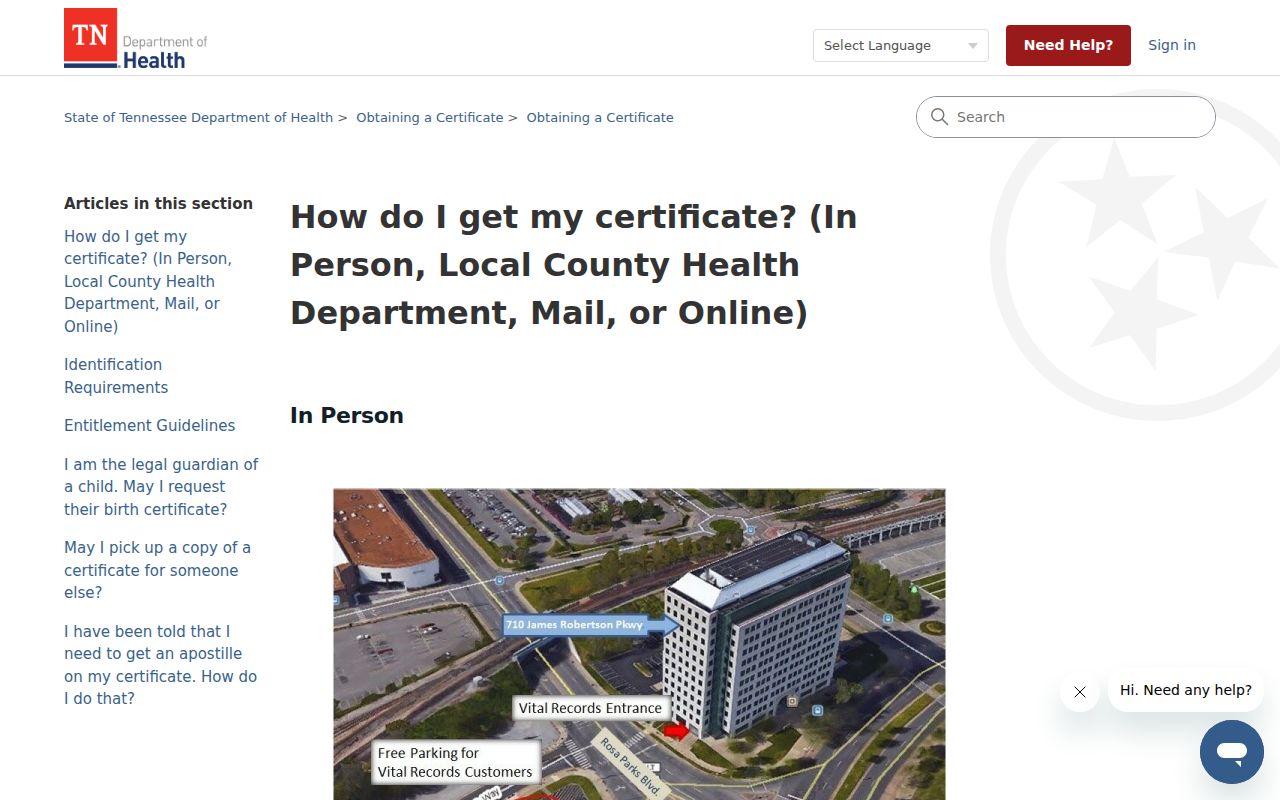
For older family-history questions, WCPL and archival indexes may provide notices, burial material, or references, but they are not automatically certified copies.
Verify a Franklin Resident Match
A careful resident lookup builds a chain rather than trusting one screen. Start with the least sensitive source and record each role separately. The aim is a supported connection at a given time, not a claim that every person associated with a name lives at one address.
- Search the Archives with exact spelling and a useful record group. Save the date and reference to the book, reel, or file.
- When a parcel is relevant, compare the assessor's owner, situs, mailing, parcel, and sale clues. A mailing address and situs answer different questions.
- Use the voter form only with its five required fields, or use TnCIS when a case clue exists. Record restrictions as well as results.
- Confirm with a second independent official or archival source. Request a certified copy from the custodian only when necessary and authorized.
- Docket
- A court's running list of case events and filings. It identifies a case but may not display every document.
- Index and image
- An index points to a record. An image is a scan of a record and may have separate access or payment rules.
- Certified copy
- A custodian-issued copy authenticated for an authorized purpose. It is different from a search result or informal scan.
Franklin Evidence Notes
Keep a short inventory with each Franklin resident lookup: the exact name entered, name variants, selected court or record group, source URL, inspection date, result reference, and limitation. For a court item, add the party role, case number, filing date, disposition, and any document restriction. For an Archives hit, include the record group, date, reel or book reference, and whether a staff visit is still needed. This turns a name search into a reproducible record trail.
- Assessor output supports assessed ownership, not every person at the property.
- A deed supports the legal party and transfer date, not continuous residence.
- A voter match supports limited registration information, not a household roster.
- A court party supports a case connection at a time, not residence by itself.
- A dated directory or obituary needs a publication date and independent corroboration.
Franklin Resident Lookup Privacy
The Tennessee Public Records Act generally allows Tennessee citizens to inspect nonconfidential records held by the correct custodian, but it is not one central resident database. A specific request should name the record type, subject, date range, office, and whether inspection or copies are wanted. The state Open Records Counsel describes in-person inspection and phone, fax, mail, email, or portal channels. Records can be redacted, and court, voter, vital, and other special rules still control access.
Tennessee Safe at Home provides a substitute address for eligible participants. It does not erase prior records or replace an address in a property-tax assessment or recorded real-property document. Never use a deed, map, or partial result to defeat an address-confidentiality program. To correct a wrong record, contact the originating custodian with the relevant instrument, case, voter, or license identifier and supporting documentation.
Lawful use. Use a Franklin resident lookup for personal, lawful research and respectful family or civic questions. Tennessee law prohibits stalking and harassment, so do not use public records to watch, threaten, or contact someone against their wishes.