
Sources for Franklin Previous Residents
Different sources answer different parts of an address history. A deed names legal parties to a transfer. An assessor record ties an owner display to a current parcel. A directory, newspaper, or census record can give a dated household clue. None alone makes a complete list of previous residents at a property. Franklin research is strongest when the source is matched to the era and the result is labeled as ownership, correspondence, address, or occupancy evidence.
| Source | Years It Covers | Where Held | What It Shows |
|---|---|---|---|
| Register of Deeds chain | 1966-present starting rule | Register of Deeds; Professional Access or TitleSearcher | Recorded parties, instrument, legal description, and prior references |
| Archives deed indexes | 1786; 1792-1963; 1977 listing | Williamson County Archives Reading Room | Historical deed references and bound-book or microfilm leads |
| TSLA direct and reverse indexes | 1799-1966, in stated reel ranges | Tennessee State Library and Archives | Grantor and grantee routes into older instruments |
| WCPL city directories and newspapers | Exact Franklin directory run not located online | WCPL Special Collections | Dated address, name, and local-context leads |
| Sanborn and historic-property material | Sheet dates must be confirmed | Library, TSLA, and local historic sources | Building and neighborhood context, not a resident list |
Start with the newest deed when the transfer is recent. For a pre-1966 question, start with the historical index and microfilm route. If the question is about a person rather than legal ownership, bring in a dated directory, obituary, tax, probate, court, church, or cemetery source after the property chain is established.
Franklin Address Records Begin Here
Williamson County Property Search accepts owner name, property address, subdivision, city, lot, map, parcel, and sale-date clues. Its visible results can show owner or owners, property address, city, parcel description, lot number, sale date, and price. Start by preserving the property or situs address, parcel or map reference, legal description, subdivision and lot, plus the sale clue. This creates a stable bridge to the Register and historical maps when an older source uses a different street label.
Keep the tax mailing address separate from the situs address. A mailing address can be a post-office box, agent, another property, former address, or a place where an owner receives correspondence. It does not establish that the addressee lived at the Franklin property. Similarly, an assessed owner is not a complete household roster. The parcel card opens a property trail, not a list of occupants.
| Situs address | The parcel's physical location, recorded with its source spelling and number. |
|---|---|
| Mailing address | Tax-correspondence destination, kept apart from the property location. |
| Parcel or map number | A bridge between the assessor, GIS, deed, and tax research routes. |
| Legal description | The deed's property wording, often more durable than a street address. |
| Sale clue | A date or price lead that must be verified against the recorded instrument. |
Franklin Records After 1966
The local historic-home research guidance gives a clear starting rule: begin a post-1966 property chain at the Williamson County Register of Deeds. The Register is at 1320 West Main Street, Suite 201, Franklin, Tennessee 37064. Listed hours are 8:00 a.m. to 4:30 p.m., and the phone is 615-790-5706. Deed and plat questions belong with this custodian, rather than with the assessor.
Online, the county identifies Professional Access and TitleSearcher as current deed-access routes. TitleSearcher supports grantor or grantee names, subdivision, document type, document number, date ranges, legal-description searching, and book or page references. A beginning date searches forward; an ending date searches from 2000 to the selected date according to the help material. A cross-reference or refer-back can point from one instrument to an earlier one. Portal images may require payment, and an online image is not the same as a certified copy from the custodian.
Note: A TitleSearcher item marked “Not Indexed” may not yet show verified property, grantor, or grantee information, so confirm it with the Register before treating it as a completed link.
Franklin Records Before 1966
Pre-1966 deeds follow a different route. The Archives site index lists Register of Deeds deed books from 1786 and 1792-1963, plus a 1977 listing. The Tennessee State Library and Archives inventory identifies deed-index volumes 1-3 for 1799-1883 on reel 129; volumes 4-6 for 1883-1927 on reel 130; volumes 7-9 for 1927-1944 on reel 131; volumes 10-11 for 1945-1950 on reel 132; and direct and reverse A-K and L-Z indexes for 1951-1966 on reels 133-136.
The Williamson County Archives search is free and supports name, keyword, and field searching, but a result may be a reference to a reel, bound book, or loose file rather than a download. The Reading Room at 611 West Main Street is the follow-up location. Contact staff before visiting and preserve the record group, volume, reel, date, and reference from every index result.
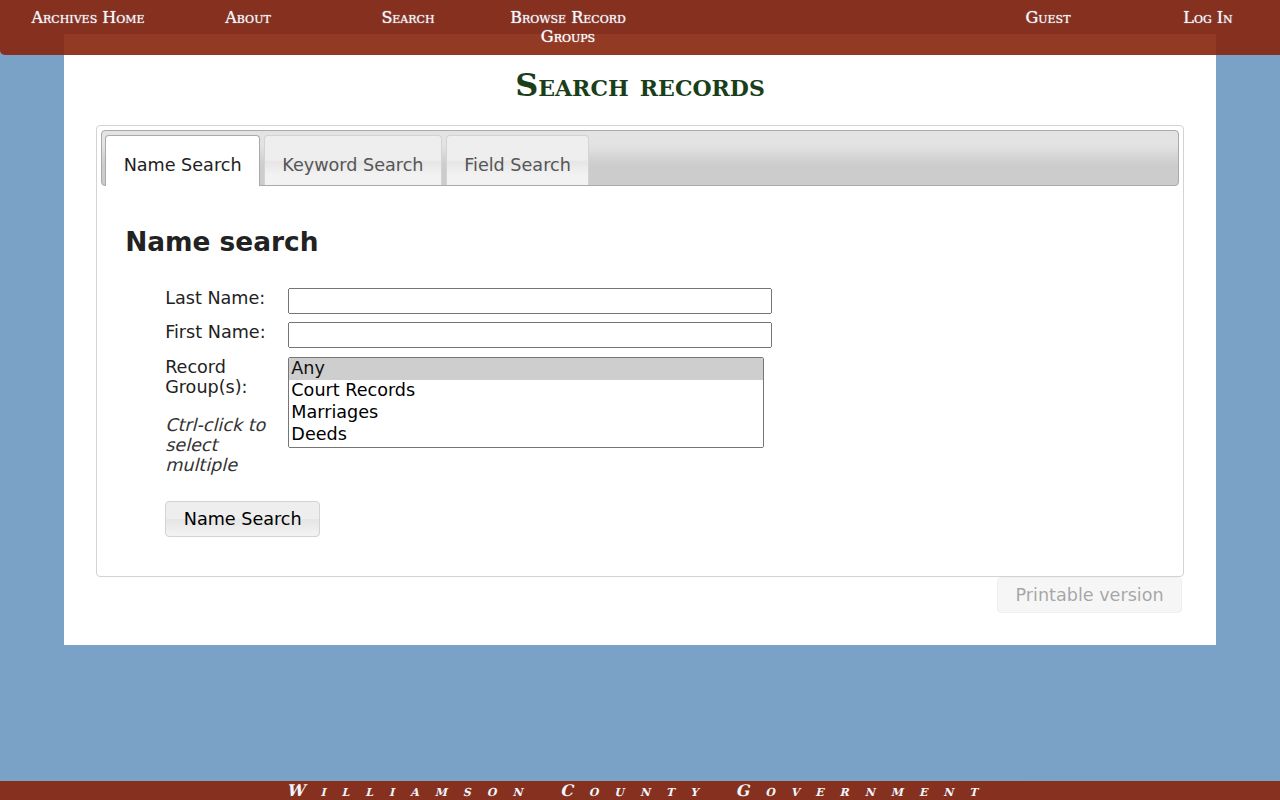
The Archive search controls support an orderly handoff from a name or keyword to the particular historical item. They do not establish that every historical instrument has been digitized or that an index result names an occupant.
Trace Franklin Address Records Backward
Follow the legal chain from the property, not merely from a familiar street name. Each conveyance usually links a grantor, the seller or transferor, with a grantee, the buyer or recipient. Parties can also be spouses, estates, trustees, corporations, banks, or other entities. Record the legal description and each prior-document reference before deciding that successive records concern the same Franklin parcel.
- Use the assessor result to capture the current parcel number, situs, legal description, and a latest sale clue.
- Locate the latest deed through the Register route, then record grantor, grantee, instrument or book and page, execution and recording dates, consideration, and legal description.
- Follow the cited prior deed backward. If no refer-back appears, search the known seller as a grantee to find the earlier purchase.
- Check cross-references, marital status, estate representatives, releases, and corporate authority before connecting a party to the property.
- Move to Archives or TSLA microfilm when the trail reaches the pre-1966 period, keeping the current record and historical reference together.
- Grantor
- The person or entity transferring an interest in the instrument.
- Grantee
- The person or entity receiving that interest. A grantee name is a legal-party clue, not proof of residence.
- Chain of title
- The sequence of recorded transfers and related instruments used to trace ownership interests backward.
- Legal description
- The deed's parcel wording, such as a lot, subdivision, acreage, or metes-and-bounds description, used to distinguish land when street labels change.
Franklin House Records Are Not Occupancy
A property history and a house history are related but different. Deeds, tax books, and probate records help establish the land and legal transfers. Local books, surveys, newspapers, permits, and historic maps can supply building context. A building footprint, aerial, permit, or listing may show physical change, but it does not identify every person who lived there.
The local guide limits cited Sanborn Insurance Map coverage to Downtown Franklin. Those maps can show mapped-date building footprints, uses, materials, and adjacent features. They are not a full Franklin household directory, and the inspected research did not locate exact sheet years or a complete address-by-year table. Use the library or TSLA catalog to identify an actual sheet and record its date and page.
When a transfer breaks because of an estate, trust, foreclosure, marriage, or partition, add probate, chancery, court, tax, church, cemetery, or newspaper research. That can explain why a legal chain changes without turning a single document into evidence of a household.
Franklin Past Residents in Dated Sources
Ownership is only one part of who lived here before. City directories, newspapers, obituaries, cemetery records, probate files, and historical census material can offer dated household evidence. The directory holdings themselves are handled in the Franklin city directories collection; exact Franklin directory years and address-first coverage should be confirmed with Special Collections rather than assumed. Compare each source's date to the deed sequence.
A practical pairing method is simple: identify the address or household in an inspected directory or newspaper, preserve that publication date, then compare it with the closest relevant historical census record and county records. Check spelling, age or family relationship, street or locality, and the property's legal trail. That comparison gives a previous residents finding a date and source boundary. If the historic street name cannot be reconciled, report the uncertainty rather than inserting a modern address.
An obituary can supply a former address, relatives, church, cemetery, or other place clue. A probate file may identify heirs or an estate transfer. Neither should be treated as a current address. Keep each entry as a dated fact, with its holding institution and reference.
Lawful house history. Use Franklin past-resident research for family history, estate questions, and property curiosity. Do not use historical or current details to harass, stalk, or track a living person.
Franklin Address Crosswalk Records
Old routes, numbered streets, subdivisions, postal labels, and municipal growth can produce more than one description for the same place. Preserve the original number, direction, street type, unit, subdivision, city, ZIP, parcel ID, and map or tax-grid reference before normalizing anything. Test variants such as West Main Street and Main Street, or a rural route against the legal description and adjoining-owner clues in deeds and plats.
Williamson County was formed in 1799 from Davidson County, and Franklin became the county seat. When an early property trail predates later municipal growth, test Williamson County books first, then consider Davidson predecessor material if the deed, church, census, or newspaper places the event outside the later Franklin line.
The City GIS offers address points, parcels, streets, subdivisions, buildings, historic-property layers, and other map context. Use a current GIS point as a dated crosswalk, not as a replacement for the wording in an old deed or directory. For an unresolved Franklin address, compare the parcel geometry with successive legal descriptions, plats, tax records, and local newspaper references.
Access is not limited to the web. Historical work may require the Archives Reading Room, WCPL Special Collections, TSLA microfilm or catalog help, a phone call to the Assessor at 615-790-5708 or Register at 615-790-5706, a defined county records request, or a custodian copy. Ask for a specific parcel, book and page, tax year, or instrument rather than an open-ended request for every record.